





Table of Content
- What Is the Difference Between Traditional Software and AI-Driven Solutions?
- Why Are Businesses Moving Beyond Traditional Software?
- Key Business Applications of AI-Powered Software Solutions
- How AI Software Development Solutions Help Businesses Grow
- Understanding AI Development Cost: What Should Businesses Expect?
- Traditional Software vs AI-Powered Software: Which Is Right for Your Business?
- How to Get Started with AI-Driven Software Development
- Conclusion
Key Takeaways
- AI is making business software smarter and more adaptive.
- Intelligent automation reduces manual work and improves productivity.
- AI enables faster, data-driven business decisions.
- Personalized experiences improve customer satisfaction.
- Custom AI solutions support business growth and scalability.
- AI development cost depends on project complexity and requirements.
- Combining traditional software with AI delivers greater flexibility.
Businesses today need software that does more than execute predefined instructions. They need systems that can understand data, identify patterns, automate complex tasks, and support faster decisions. This is why organizations are increasingly investing in AI software development solutions to modernize operations and improve business performance.
Traditional software remains essential for structured processes, but it can struggle when business requirements involve changing customer behavior, large datasets, and unpredictable situations. AI-driven solutions bridge this gap by combining conventional software capabilities with machine learning, predictive analytics, and intelligent automation.
For business owners and technology leaders, the shift is not simply about adopting new technology. It is about building more responsive, efficient, and scalable business operations.
Ready to Move Beyond Traditional Software
Explore how custom AI solutions can help your business automate operations and improve efficiency.
Explore AI Development Services
What Is the Difference Between Traditional Software and AI-Driven Solutions?
Traditional software runs on predefined rules, instructions, and workflows developers create. It performs specific tasks consistently when users provide expected inputs.
AI-driven software uses artificial intelligence and machine learning to analyze information, recognize patterns, generate predictions, and support decisions. Unlike conventional systems, it can adapt its outputs based on data, model improvements, and changing business requirements.
| Comparison | Traditional Software | AI-Driven Software |
|---|---|---|
| Operations | Follows predefined rules | Uses data-driven intelligence |
| Automation | Automates structured tasks | Supports complex, adaptive workflows |
| Decision-making | Relies on programmed logic | Identifies patterns and generates insights |
| Personalization | Uses predefined settings | Adapts to customer behavior |
| Predictive capabilities | Limited without additional logic | Supports forecasting and prediction |
| Data processing | Primarily structured inputs | Can analyze structured and unstructured data |
For example, a traditional inventory system may notify a manager when stock reaches a predefined level. An AI-powered system can analyze historical sales, seasonal demand, and supply patterns to forecast potential shortages.
The two approaches are not mutually exclusive. Many modern business applications combine traditional software architecture with AI capabilities.
Why Are Businesses Moving Beyond Traditional Software?
Growing demand for operational efficiency, better customer experiences, and faster decisions is pushing businesses to explore AI-powered technologies.
Here are the major reasons behind this transition.
1. Intelligent Automation Improves Productivity
Traditional automation handles repetitive tasks with predefined instructions. AI extends these capabilities by processing documents, understanding requests, categorizing information, and supporting more complex workflows.
For example, an AI-powered finance application can extract information from invoices, categorize expenses, and flag unusual transactions for human review.
This reduces repetitive work and allows employees to focus on activities that require business judgment.
2. Faster, Data-Driven Decision-Making
Businesses generate information through sales platforms, CRM systems, customer interactions, and operational tools. However, disconnected data makes it difficult to identify meaningful insights.
AI software can analyze large datasets, identify trends, and generate predictive insights that support better decisions.
For example, sales managers can use predictive analytics to identify potential customer churn, forecast revenue, and prioritize high-value opportunities.
3. More Personalized Customer Experiences
Customers expect relevant recommendations, quick responses, and consistent interactions across digital channels.
AI-powered software solutions can analyze browsing behavior, purchase history, and customer preferences to deliver personalized experiences.
E-commerce platforms, for instance, can recommend products based on customer interests rather than relying exclusively on manually configured product categories.
4. Better Scalability and Business Flexibility
As organizations grow, manual processes and rigid workflows can become operational bottlenecks.
AI-driven applications help businesses process increasing volumes of information, automate additional workflows, and support changing operational requirements.
However, scalability still depends on software architecture, infrastructure, data quality, and integration planning—not AI alone.
5. Predictive Insights and Reduced Operational Inefficiencies
Traditional reporting generally explains what has already happened. AI-based analytics can help businesses understand what may happen next.
Manufacturers can use predictive maintenance to identify equipment performance patterns and schedule inspections before potential failures.
Similarly, logistics businesses can analyze delivery patterns, demand fluctuations, and operational data to improve planning.
6. Competitive Advantage Through Innovation
Businesses that identify valuable AI applications can improve existing services, develop new digital products, and respond more effectively to changing customer expectations.
The opportunity is not simply to automate existing work. It is to rethink how products, services, and business processes can operate.
Key Business Applications of AI-Powered Software Solutions
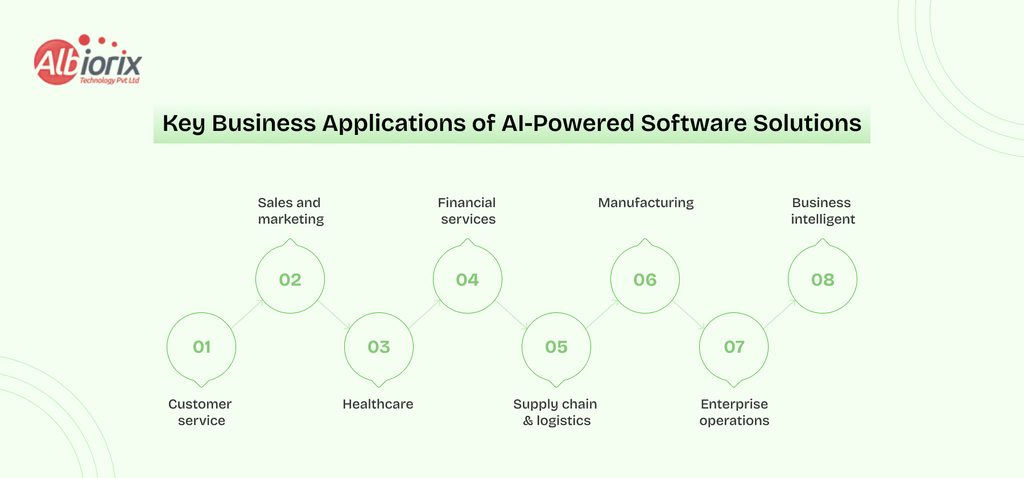
AI adoption is expanding across industries because its applications extend beyond chatbots and content generation.
Some practical examples include:
- Customer service: AI chatbots and virtual assistants answer common questions, retrieve information, and support customer service teams.
- Sales and marketing: Predictive lead scoring, customer segmentation, personalized campaigns, and sales forecasting help teams prioritize opportunities.
- Healthcare: AI applications assist with medical documentation, administrative workflows, image analysis, and patient engagement, subject to appropriate clinical oversight.
- Financial services: Fraud detection, transaction monitoring, risk assessment and document processing help financial organizations improve operational controls.
- Manufacturing: Predictive maintenance, quality inspection, and production forecasting support more efficient operations.
- Supply chain and logistics: AI helps forecast demand, optimize inventory, and identify potential delivery disruptions.
- Enterprise operations: Intelligent workflow automation connects business systems and reduces manual coordination.
- Business intelligence: AI-powered reporting helps decision-makers explore operational data and identify emerging trends.
The right application depends on the industry’s challenges, available data, regulatory requirements, and expected business outcomes.
How AI Software Development Solutions Help Businesses Grow
Off-the-shelf applications can address common requirements, but businesses with specialized workflows often need solutions designed around their operations.
Custom AI software development solutions help organizations build applications that combine their existing software infrastructure with intelligent capabilities.
These solutions can support business growth through:
Custom AI application development: Develop applications with machine learning, natural language processing, computer vision, or generative AI capabilities according to specific business requirements.
Integration with existing systems: Connect AI functionality with CRM, ERP, inventory management, customer portals, and other enterprise applications instead of replacing every existing platform.
Intelligent workflow automation: Automate document processing, customer requests, internal approvals, and information management.
AI-powered business intelligence: Transform operational data into actionable insights through predictive analytics, intelligent reporting, and decision-support tools.
Scalable digital transformation: Modernize legacy applications and introduce AI capabilities gradually, based on business priorities and technical feasibility.
For example, a growing retail business may integrate AI-powered recommendations into its existing e-commerce platform rather than building an entirely new application.
This approach helps businesses improve existing investments while introducing capabilities that support future growth.
Have an AI Software Idea?
Turn your business requirements into scalable AI-powered applications with the right development approach.
Discuss Your AI Project
Understanding AI Development Cost: What Should Businesses Expect?
AI development cost depends on the functionality, complexity, and long-term requirements of the project. A simple AI feature integrated into an existing application requires a different investment from a custom enterprise platform.
Several factors influence the overall development budget:
- Project complexity: Basic AI automation, predictive analytics, and multi-step AI agent systems require different levels of engineering effort.
- AI model selection: Using commercial AI APIs, open-source models, or custom-trained models affects development and operational expenses.
- Data quality and preparation: Collecting, cleaning, organizing, and securing business data can significantly influence project requirements.
- Third-party integrations: Connecting AI applications with existing CRM, ERP, payment, or enterprise systems adds integration work.
- Infrastructure requirements: Cloud hosting, computing resources, storage, and model usage influence ongoing expenses.
- Security and compliance: Access controls, encryption, auditability, privacy, and industry-specific requirements must be considered.
- Maintenance and optimization: Model evaluation, monitoring, updates, and performance improvements create continuing costs.
Businesses should evaluate both initial development investment and ongoing operating expenses.
Rather than choosing AI simply because it is trending, decision-makers should compare the expected business value with development, integration, and maintenance costs.
Traditional Software vs AI-Powered Software: Which Is Right for Your Business?
The right choice depends on the nature of your business problem.
Traditional software is often sufficient when processes follow stable rules and require predictable outcomes. Billing systems, payroll calculations, access controls, and transaction processing are examples where conventional software remains highly effective.
AI-powered software makes more sense when applications need to interpret complex information, identify patterns, personalize interactions, or generate predictions.
For many organizations, the most practical solution is a combination of both.
A business management platform, for example, can continue using traditional software for financial calculations and permissions while integrating AI for demand forecasting, customer insights, and automated document processing.
The objective should be to use AI where it creates meaningful value, not to introduce unnecessary complexity.
How to Get Started with AI-Driven Software Development
Businesses do not need to transform their entire technology infrastructure at once. A structured implementation approach can reduce investment risks and improve adoption.
- Identify business challenges: Find processes that involve repetitive work, operational delays, disconnected information, or poor customer experiences.
- Define measurable objectives: Establish clear KPIs such as processing time, customer response time, forecast accuracy, or operational costs.
- Select suitable AI use cases: Prioritize applications where AI offers an advantage over conventional automation.
- Evaluate data readiness: Assess data availability, quality, privacy, and integration requirements.
- Choose the right development partner: Look for experience in software engineering, AI integration, security, deployment, and ongoing support.
- Start with a pilot project: Test one focused use case before committing to a large-scale implementation.
- Measure results and scale: Evaluate performance, gather user feedback, and expand successful applications gradually.
A practical implementation strategy should also include human oversight, security controls, and continuous performance evaluation.
Conclusion
The shift from traditional software to AI-driven solutions reflects changing business expectations. Organizations increasingly need applications that can process information intelligently, automate complex workflows, personalize customer experiences, and support better decisions.
However, AI is not a replacement for every traditional software capability. The strongest business solutions combine reliable software engineering with AI where it delivers measurable value.
At Albiorix Technology, businesses can explore custom AI software development, intelligent automation, and AI integration approaches aligned with their operational requirements and growth objectives.
Looking to modernize your business software with AI? Connect with the Albiorix Technology team to discuss your requirements and identify the right AI development approach for your business.
Connect with Our Experts!
FAQ
Frequently Asked Questions
Businesses are adopting AI-driven software to automate complex tasks, reduce manual effort and improve decision-making. These solutions also help deliver personalized customer experiences and improve operational efficiency.
Traditional software follows predefined rules, while AI-powered software analyzes data, identifies patterns and generates predictions. It enables intelligent automation and more adaptive business operations.
AI software solutions improve productivity, automate workflows, enhance customer experiences and support faster decisions. They also help businesses identify opportunities through predictive analytics.
Healthcare, finance, retail, manufacturing, logistics and education benefit from AI-powered software. Common applications include fraud detection, predictive maintenance, inventory forecasting and intelligent customer support.
AI development cost depends on project complexity, model selection, data preparation, integrations and infrastructure requirements. Ongoing maintenance, security and optimization also influence the overall investment.
Yes. AI can be integrated into existing CRM, ERP, e-commerce and enterprise applications using APIs, AI models and custom software development. This allows businesses to introduce intelligent features without completely replacing their existing systems.
Custom AI software is suitable for businesses with unique workflows, specialized requirements or complex integrations. Ready-made AI tools work well for common tasks and faster adoption. The right choice depends on business objectives, budget, scalability and customization needs.
Businesses should evaluate a development company’s AI expertise, software engineering experience, integration capabilities, security practices, industry knowledge and project portfolio. Look for a partner that understands business challenges and can deliver scalable, maintainable AI solutions.
Published Blogs
Latest Blogs : Insights and Innovations from Our Blog
Stay Ahead in Tech: Dive into our Blogs for the Latest in Software, Web, and Mobile App Development. Explore cutting-edge technologies, industry trends, and insightful updates that keep you at the forefront of the digital landscape


Our Clients

Client Showcase: Trusted by Industry Leaders
Explore the illustrious collaborations that define us. Our client showcase highlights the trusted partnerships we've forged with leading brands. Through innovation and dedication, we've empowered our clients to reach new heights. Discover the success stories that shape our journey and envision how we can elevate your business too.


Build Together With
Albiorix Technologies
Partner with us to transform your ideas into powerful, scalable digital products. From design deployment, we deliver with precision and care.
0+
Digital Projects Completed
0+
AI Solutions Delivered
0+
Seasoned Developers
0+
Years of Experience


